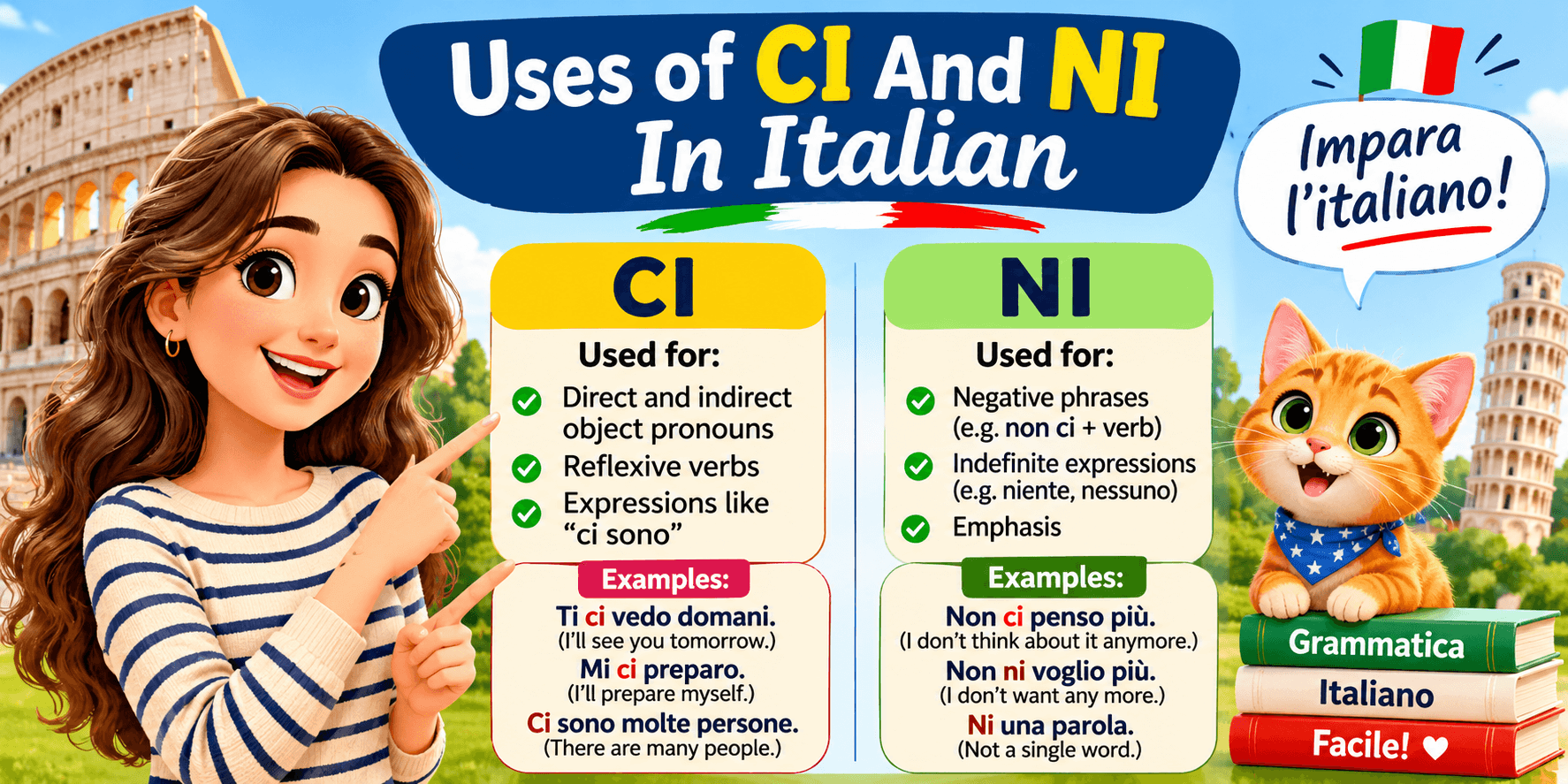
The two topics “CI” and “NE” are difficult. But in this article, we make it simple to learn their uses. Do you know how to use CI and NE in Italian?.
Well, the particle CI of Italian is mostly used in 4 different ways. Let’s discuss each case one by one and learn italian:
Uses of CI:
Case1 .For “CI”.Pronomi Diretto(NOI-US)
In sentences where we use the phrase ” us “.
For Instance:
- In English: Tony saw us on the bus.
- In italian :Tony Ci ha visti sull’autobus.
In this sentence, CI represents a direct pronoun, which refers to NOI in Italian.In easy language, it replaces us .
Case 2. FOR CI :Pronomi Indiretto(NOI- To US)
In sentences, when we use the phrase”to us”, it will be replaced with Noi. Let’s understand with an example.
For Example:
- In English:Tony lent the book to us.
- In Italian:Tony ci ha prestato il libro.
The verb prestare needs the preposition “a”.The meaning of prestare is to give something to someone for a short time with the promise that they will give it back)
- In English:Tony lent the book to us.
- In Italian:Tony ci ha prestato il libro.
Case 3. For CI.Location(li,la:There)
In sentences in which you represent location. The most important use is in sentences where you will use the verb essere (Esserci).
Example 1: “There”
- In Italian:Oggi vado a scuola. Ci vado a piedi.
- In English: Today I go to school. I go there on foot.
In these sentences, the location is “school” and “There”.
Example 2.Esserci CI+essere=to be”
1. Ci Sono: There is
2.C’è:There are
Case 4 For CI: Replacing A Sentence or Part OF IT
In this case “CI” replaces a sentence or a part of a phrase.
- In English: I like this job. I care a lot about it.
- In italian:Mi piace questo lavoro.CI tengo molto.
In the above example, “CI” replaces questo lavoro and about it. But in the above sentence, the phrase “about it” is replaced with “CI”.
NE
NE particle (particella in Italian) is a bit easier than CI.It is used mostly in two cases. Let’s dig deep into the 2 use cases of “NE”.
Case1 .For “NE”:Di Lei/Loro/Questo Or Da Lui/Loro/Questo :
For Example1:
- In English: Tony has 2 dogs. He always talks about them.
- In Italian: Tony ha 2 cani.Ne parla sempre.
In the above, since NE replaces the phrase about them.
Example 2
- In English:I worked a lot. But I earned nothing from it.
- In Italian:Ho lavorato tanto.Ma non NE guadagnato nulla.
In this sentence, ” it is replaced with “NE”.
The verb guadagnare means “to earn,” “to win,” or “to gain”.It is used as guadagnato, which means earned.
Use Case2. For NE: A Part of Something bigger
Example:
- In English:You want some ice cream? Yes I want some of it.
- In Italian: Voui del gelato?Si,NE voglio in pó.
Here, to represent some part of it, “NE” is used.
Conclusion
The “CI” is used in those sentences where you have to replace us (NOI), to us. Also, “CI” is used in sentences where you mention locations, like there is or there are Ci sono or C’è ). The other use of CI in sentences where you have to replace a part of a phrase, like about it can be replaced with CI in the above-discussed example.
The other particle NE simply has 2 different uses. The foremost use of it is for location purposes. Like for Lei/Loro/Questo. The other use of NE is for replacing “part of something in a sentence”.
