Italian prepositions are the words that help to connect different parts of a sentence. They indicate important relationships such as place, time, direction, origin, possession, purpose, etc. It is too important to learn them if you want to speak and write Italian well. There are a total of 9 prepositions in italian. The most common Italian prepositions are di, a, da, in, con, su, per, tra, and fra. In this guide, you’ll learn the meaning and everyday use of each Italian preposition through simple explanations, practical examples, and English translations. By understanding these common patterns, you can build clearer Italian sentences and communicate more confidently in everyday conversations. Let’s discuss them one by one.
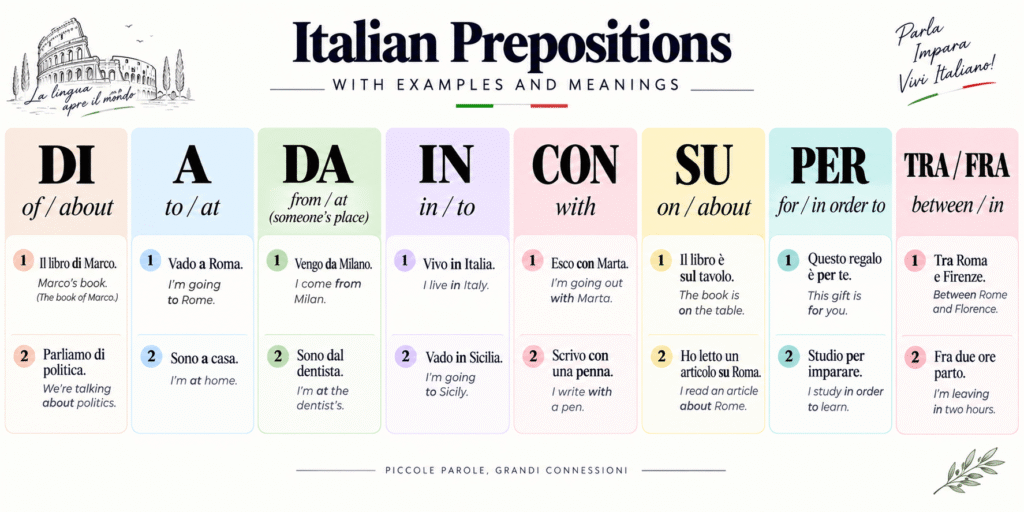
DI
| 1. DI — OF | 2. DI — ABOUT |
|---|---|
| Used to indicate possession, origin, material, part–whole, and many other relations. | Used to talk about topics, subjects, or things in a general sense. |
| È la macchina di mio fratello. — It’s my brother’s car. | Parliamo di lavoro. — We’re talking about work. |
| Un bicchiere di vino, per favore. — A glass of wine, please. | Ho letto un articolo di tecnologia. — I read an article about technology. |
| Sono di Catania. — I’m from Catania. | Non so nulla di lui. — I don’t know anything about him. |
| Una fetta di torta. — A slice of cake. | Mi piace parlare di viaggi. — I like talking about travel. |
A
| 1. A — TO | 2. A — AT |
|---|---|
| Used to indicate direction, destination, or the person something is given or said to. | Used to indicate where someone or something is, or where an action happens. |
| Vado a Roma domani. — I’m going to Rome tomorrow. | Sono a casa tutto il giorno. — I’m at home all day. |
| Scrivo a Giulia stasera. — I’m writing to Giulia tonight. | Ci vediamo al bar alle otto. — We’ll meet at the bar at eight. |
| Do il libro a Marco. — I’m giving the book to Marco. | Lei è a scuola adesso. — She’s at school now. |
| Torniamo a casa presto. — We’re going home early. | Mio padre è al lavoro. — My father is at work. |
DA
| 1. DA — FROM | 2. DA — AT / BY |
|---|---|
| Used to indicate origin, starting point, distance, or movement away from a place. | Used for someone’s place, the agent in passive sentences, or duration/starting time in some expressions. |
| Vengo da Milano. — I come from Milan. | Stasera ceno da Luca. — Tonight I’m having dinner at Luca’s place. |
| Torno da Roma domani. — I’m coming back from Rome tomorrow. | Passo dal dottore dopo lavoro. — I’m stopping by the doctor’s after work. |
| Abito a cinque minuti da qui. — I live five minutes from here. | Il libro è stato scritto da Calvino. — The boo |
IN
| 1. IN — IN | 2. IN — TO / BY |
|---|---|
| Used to indicate being inside a place, a time period, a season, or a language. | Used for movement to places such as countries, regions, or certain buildings, and with means of transport. |
| Vivo in centro. — I live downtown. | Domani andiamo in Toscana. — Tomorrow we’re going to Tuscany. |
| Il latte è in frigo. — The milk is in the fridge. | Vado in banca prima di pranzo. — I’m going to the bank before lunch. |
| Andiamo al mare in estate. — We go to the beach in summer. | Sono arrivati in treno. — They arrived by train. |
| Questo libro è in italiano. — This book is in Italian. | Vai in ufficio oggi? — Are you going to the office today? |
Con
| 1. CON — WITH (PEOPLE) | 2. CON — WITH (THINGS / MEANS) |
|---|---|
| Used to indicate company, to say you are with someone. | Used to indicate the instrument, means, or way something is done. |
| Esco con i miei amici. — I’m going out with my friends. | Scrivo con una penna. — I write with a pen. |
| Vado al cinema con mia sorella. — I’m going to the cinema with my sister. | Taglio il pane con un coltello. — I cut the bread with a knife. |
| Ceno con Marco stasera. — I’m having dinner with Marco tonight. | Pago con la carta. — I pay with a card. |
| Lavoro con un team internazionale. — I work with an international team. | Viaggio con il treno. — I travel by train. (with the train) |
SU
| 1. SU — ON | 2. SU — ABOUT |
|---|---|
| Used to indicate position on a surface, or sometimes movement to a higher place. | Used to talk about a topic, subject, or in reference to something. |
| Il libro è sul tavolo. — The book is on the table. | Ho letto un articolo su Roma. — I read an article about Rome. |
| Il telefono è sopra la scrivania. — The phone is on the desk. | Parliamo un po’ su questo tema. — Let’s talk a bit about this topic. |
| Ho messo le chiavi sul divano. — I put the keys on the sofa. | Ho delle domande su il corso. — I have some questions about the course. |
| Saliamo su al piano di sopra. — Let’s go up to the upper floor. | Puoi darmi più informazioni su questo? — Can you give me more information about this? |
PER
| 1. PER — FOR | 2. PER — THROUGH | 3. PER — IN ORDER TO |
|---|---|---|
| Used to indicate purpose, someone’s benefit, duration of time, or exchange. | Used to indicate movement through a place, means of transport, or a method. | Used to express a goal or purpose (equivalent to “to” in English). |
| Questo regalo è per te. — This gift is for you. | Passiamo per il centro. — We go through the city center. | Studio per migliorare il mio italiano. — I study in order to improve my Italian. |
| Lavoro per un’azienda internazionale. — I work for an international company. | Cammino per il parco. — I walk through the park. | Lavoro per avere più libertà. — I work in order to have more freedom. |
| Studio italiano per piacere. — I study Italian for pleasure. | Abbiamo viaggiato per l’Europa in treno. — We traveled through Europe by train. | Mi alleno per stare in forma. — I train in order to stay fit. |
| Ti aspetto per un’ora. — I’ll wait for you for an hour. | Lo dice per esperienza. — He says it through experience. | Risparmio per comprare una casa. — I save in order to buy a house. |
TRA AND FRA
| 1. TRA | 2. FRA |
|---|---|
| Used to indicate a relationship between people, things, or places. | Used in the same way as tra, but it is more formal and common in written Italian. |
| C’è un’amicizia tra loro. — There is a friendship between them. | C’è un accordo fra le due aziende. — There is an agreement between the two companies. |
| Vivo tra Milano e Bologna. — I live between Milan and Bologna. | Viaggio fra Roma e Firenze. — I travel between Rome and Florence. |
| Il volo è tra due ore. — The flight is in two hours. | La riunione è fra un’ora. — The meeting is in one hour. |
| Scegliamo tra queste opzioni. — Let’s choose between these options. | Dobbiamo scegliere fra due possibilità. — We have to choose between two possibilities. |
| Ho diviso la torta tra tutti. — I divided the cake among everyone. | La somma va divisa fra tutti. — The amount should be divided among everyone. |
